
Last updated September 25, 2026
Free written scope consultation - allowances, timeline, and change-order rules on paper before a single trade is scheduled






 Before
 After
After Before
 After
After Before
 After
AfterKitchen Remodeling Maintenance Checklist for Mountain View Homeowners
Grout failure in a tiled kitchen backsplash typically begins at the countertop-to-tile junction within 18 months of installation if no flexible sealant joint was used - a detail that appears in zero percent of standard contractor punch lists. In Mountain View, where homeowners routinely invest $40,000 to $120,000 in our Kitchen Remodeling services, that oversight can mean water migrating behind tile, drywall damage, and a repair that costs more than the original installation. This guide gives you the maintenance schedule most contractors never write down: material-specific care intervals, hardware adjustment timelines, and the documentation you need to protect your investment for the decade ahead.
Quick Answer
A kitchen remodel in Mountain View requires quarterly inspections of plumbing and ventilation systems, semi-annual countertop sealing for natural stone, annual cabinet hardware adjustments, and immediate attention to grout joints and sealant lines. The specific schedule depends on your materials - quartz needs no sealing, Calacatta marble needs it every 6-12 months, and butcher block needs food-safe mineral oil every 3 months. Keep your permit card, inspector sign-off, appliance model numbers, and grout color code on file for any future repair, and consult more guides & resources for ongoing care.
Table of Contents
- Countertop Care by Material: Sealing, Cleaning, and Warning Signs
- Cabinet Hardware: Frameless vs. Face-Frame Adjustment Schedules
- Under-Sink Plumbing Inspections in Mountain View’s Hard Water
- Range Hood Maintenance by CFM Rating and Cooking Frequency
- Tile, Grout, and Sealant: The 18-Month Failure Point
- Appliance Maintenance Tied to Installation Documentation
- Flooring Care for Mountain View’s Climate and Soil Conditions
- The File You Need: Permits, Warranties, and Color Codes
 Before
 After
AfterCountertop Care by Material: Sealing, Cleaning, and Warning Signs
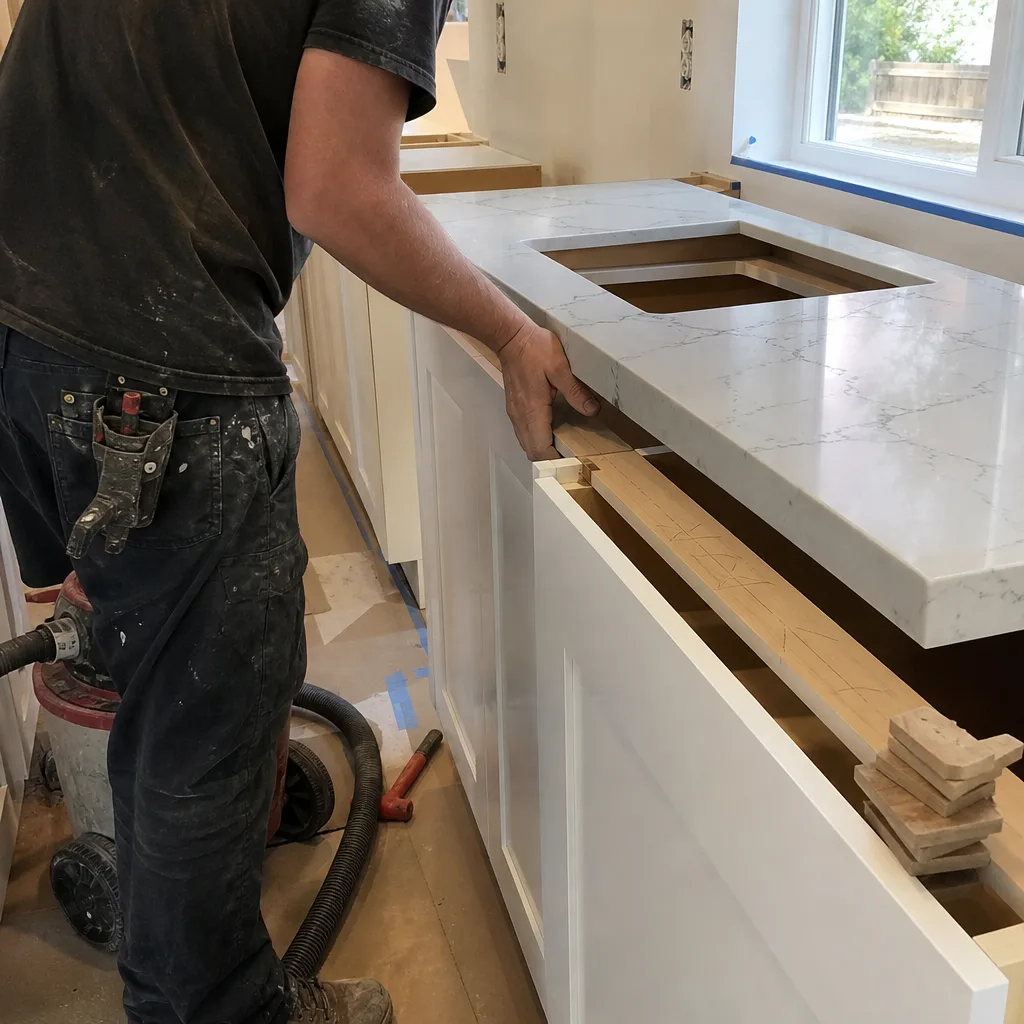
Countertops take the most visible abuse in any kitchen, and the maintenance schedule varies dramatically by material. We have replaced more countertops in Mountain View’s Old Mountain View and Monta Loma neighborhoods due to improper sealing than from actual physical damage - homeowners simply were not told what their specific surface required.
Quartz (Engineered Stone): Brands like Cambria and Caesarstone need no sealing, ever. The resin binder makes the surface non-porous. Clean with pH-neutral cleaner - avoid bleach, oven cleaner, or anything with pH outside 5-9. Heat damage is permanent and not repairable, so trivets are mandatory. We have seen quartz discoloration from a hot pan left for under 90 seconds in a Castro Street condo kitchen.
Natural Stone (Marble, Granite, Soapstone):
- Calacatta marble and other light marbles: seal every 6-12 months with a penetrating sealer. Etching from lemon juice or vinegar is immediate and permanent - it is a chemical reaction, not a stain.
- Granite: seal annually in most cases; test by dripping water on the surface. If it darkens the stone in under 10 minutes, reseal.
- Soapstone: treat with food-grade mineral oil monthly for the first year, then as needed when the surface lightens. It will scratch - that is expected patina, not damage.
Butcher Block: Apply food-safe mineral oil every 3 months, or monthly if you prep directly on the surface. In Mountain View’s dry summer months, wood can check (develop small cracks) if humidity drops below 30%. A thin coat of oil prevents this. Sand out stains or burns with 220-grit paper, re-oil, and the surface is restored.
Solid Surface (Corian, etc.): Sand out scratches with a Scotch-Brite pad in a circular motion. No sealing required. Heat damage above 212°F is permanent.
Warning signs that need immediate attention: Dark spots that grow over days (water penetration), white rings that do not wipe off (heat or chemical damage on stone), or lifting at seams (adhesive failure or moisture underneath). For any of these, stop using the area and call for assessment - the damage spreads faster than most homeowners expect.
Cabinet Hardware: Frameless vs. Face-Frame Adjustment Schedules
Cabinet doors and drawers go out of alignment. It is normal. What separates a kitchen that looks sharp after five years from one that looks tired is whether anyone tightened a screw or adjusted a hinge.
Frameless European-style cabinetry (full-overlay doors, no face frame) uses concealed hinges - typically Blum or Grass hardware in the kitchens we install. These hinges have three or four adjustment screws: depth, side-to-side, and up-down. Because the door covers the entire cabinet box edge, even 1/16 inch of misalignment is visible.
- Check alignment every 6 months: close the door and look at the gap between doors. It should be uniform top to bottom.
- Tighten the mounting plate screws first - these loosen from door weight and use. A #2 Phillips screwdriver is all you need.
- Adjust side-to-side if gaps are uneven: turn the appropriate screw 1/4 turn, test, repeat. Never force; these are precision mechanisms.
- Soft-close dampeners (Blum Blumotion, Grass Tiomos) can lose effectiveness after 5-7 years of heavy use. Replacement cartridges install with two screws.
Traditional face-frame cabinetry uses hinges mounted to the frame, with more tolerance for minor misalignment because the frame itself creates visual structure. Check annually, not semi-annually. The hinges are typically simpler - often a 35mm cup hinge or traditional butt hinge - and adjustment is limited to slotting the screw holes.
Drawer slides: Full-extension soft-close slides (Blum Tandem, Grass Dynapro) should be vacuumed of debris quarterly - crumbs and grit accelerate wear. The release levers for drawer removal should operate smoothly; if they stick, a drop of light machine oil on the mechanism restores function. In our experience across Mountain View’s Whisman Station and Blossom Valley installations, drawers in pantries near the garage entry collect the most grit from shoe traffic.
Pulls and knobs: Check set screws every 12 months. A loose pull spins, then the screw wallows out the hole, then the pull falls off and takes finish with it. Five minutes with a screwdriver prevents this.
Under-Sink Plumbing Inspections in Mountain View’s Hard Water
Mountain View’s municipal water runs approximately 17 grains per gallon - moderately hard by national standards, enough to scale fittings and degrade rubber compression components over time. The under-sink cabinet is where most kitchen water damage starts, and it is the least inspected space in most homes.
Perform this inspection quarterly:
- Run water full-blast for 60 seconds, then dry all fittings with a paper towel. Wait 5 minutes. Any new moisture indicates a seep - not yet a drip, but the precursor.
- Check the P-trap slip joints: the nylon washers harden in hard water and lose compression. Hand-tighten only; over-tightening cracks plastic traps.
- Examine flexible supply lines for corrosion at the nut threads. Braided stainless lines last 5-10 years; the rubber core degrades from the inside. We replace them proactively at 8 years in Mountain View installations.
- Test the shutoff valves: turn off, run the faucet to relieve pressure, check for seepage at the valve stem. A dripping stem usually needs a new packing washer, not a full valve replacement.
- Look at the faucet base: hard water deposits around the escutcheon indicate base leakage that runs under the counter.
Garbage disposer: Grind ice cubes monthly to clean the chamber. Never pour grease - it congeals on the chamber walls and traps debris. In hard water areas, the grind chamber develops scale that reduces efficiency; a cup of white vinegar left in the chamber for 10 minutes, then flushed, dissolves this.
Reverse osmosis or filtration systems: Change filters per manufacturer schedule, but add 20% frequency in Mountain View’s water. Scale builds faster on membranes. Document filter changes on the unit with a Sharpie - the sticker falls off, the Sharpie does not.
Range Hood Maintenance by CFM Rating and Cooking Frequency

Ventilation is the most neglected kitchen system and the one most tied to indoor air quality. A hood that does not move air traps cooking particulates, moisture, and grease on cabinets and ceilings. The maintenance schedule depends on how much air the hood moves and how often you cook.
CFM ratings and filter schedules:
- Under 300 CFM (basic builder-grade hoods): clean mesh filters monthly if you cook daily, every 6 weeks if occasional use. These hoods move so little air that filter loading chokes them quickly.
- 300-600 CFM (upgraded residential): clean baffle or mesh filters every 6-8 weeks for daily cooking. Baffle filters (stainless steel with channels) go in the dishwasher; mesh filters degrade with dishwasher detergent over time - hand-wash with degreaser.
- 600-1200 CFM (professional-style residential): clean baffle filters every 4-6 weeks. These hoods move enough air that grease loading is rapid. Check the blower wheel annually - grease accumulation on the wheel reduces efficiency even when filters are clean.
- 1200+ CFM (commercial-style in residential): these require make-up air per California Title 24, and the maintenance is semi-annual professional service. The duct run is typically longer, with more joints that collect grease.
Duct inspection: Every 12 months, check the exterior termination. The damper should open fully when the hood runs and seal when off - a stuck damper lets cold air in and warm air out. In Mountain View’s occasional rainy winters, a failed damper can allow water into the duct. Grease buildup in the duct itself is a fire hazard; if you smell rancid grease when the hood runs, the duct needs cleaning.
Charcoal filters for recirculating hoods: Replace every 6 months, without exception. They saturate and then simply blow filtered grease back into the kitchen. We do not recommend recirculating hoods for kitchens with gas cooking - they do not remove combustion byproducts.
Tile, Grout, and Sealant: The 18-Month Failure Point
This is where most kitchen maintenance guides fail entirely. They discuss grout cleaning and ignore the structural detail that actually fails.
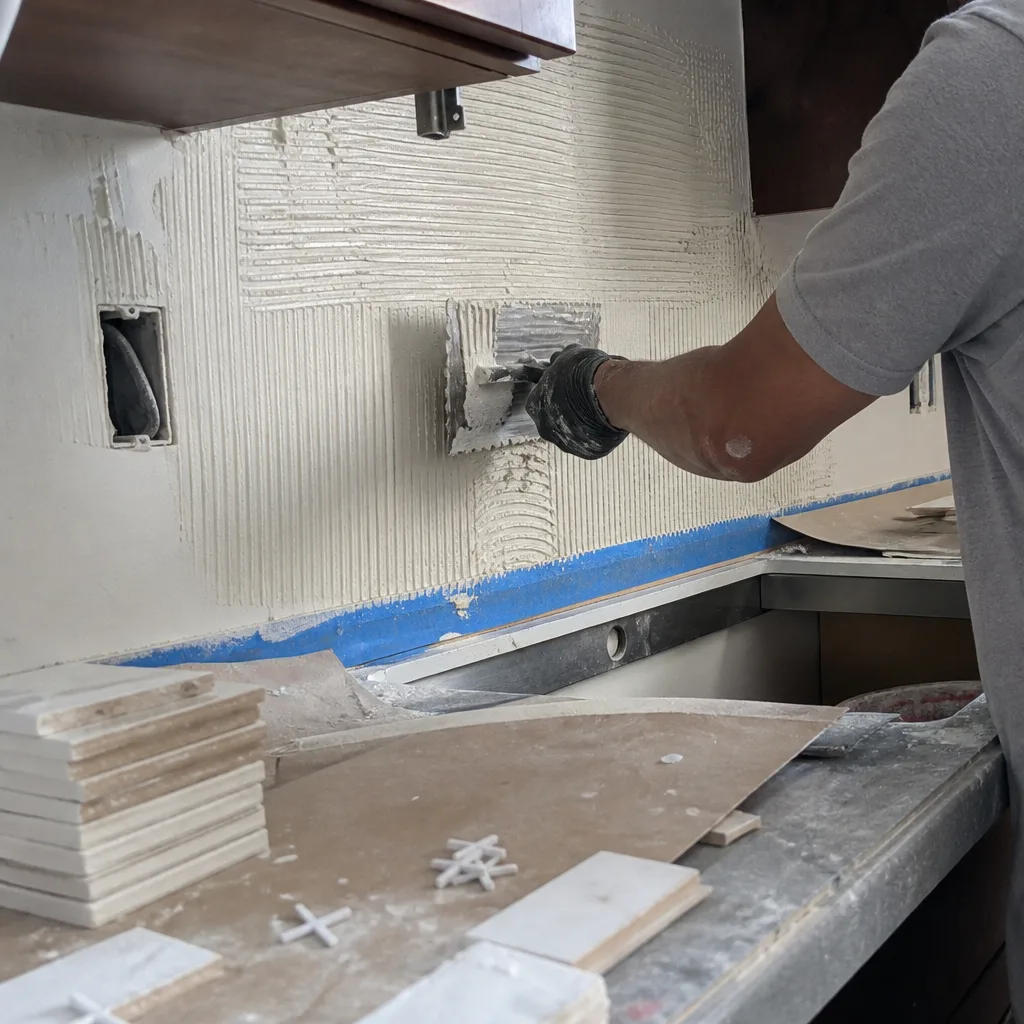
Every countertop-to-wall junction moves. The cabinet box settles slightly. The wall stud system breathes with humidity changes. The countertop material expands and contracts on a different coefficient than the wall tile. If your installer grouted that joint solid, the grout will crack - it is not an installation defect, it is physics.
The correct detail is a flexible sealant joint: color-matched silicone or polyurethane caulk, 1/4 inch wide, at every change of plane. This joint needs inspection at 6 months, 12 months, and 18 months - the critical period when installation movement completes its initial cycle. After that, annual inspection suffices.
Grout maintenance by type:
- Cementitious grout (traditional sanded or unsanded): seal annually with penetrating sealer. In Mountain View, where many homeowners cook with olive oil and acids (wine, citrus), unsealed grout stains permanently within months.
- Epoxy grout (Laticrete SpectraLOCK, etc.): no sealing required. Clean with pH-neutral cleaner; aggressive acids etch the surface over time.
- Urethane grout: no sealing, but can soften with prolonged heat exposure behind cooktops.
Cleaning: Avoid bleach on colored grout - it oxidizes pigments. Steam cleaners work well but force moisture into the wall assembly if grout is cracked; repair grout first, then steam clean.
The grout color code: When your tile installer finishes, they should leave the grout manufacturer’s color number and lot code. For future repairs - a cracked tile, a plumbing access patch - matching grout is impossible without this. We include this on our project closeout documentation for every Kitchen Remodeling in Mountain View project. If you do not have it, a grout color-matching service can analyze a sample, but the result is approximate.
Appliance Maintenance Tied to Installation Documentation
Appliances are the most replaced items in a kitchen, and the most likely to cause water or fire damage if neglected. The maintenance is straightforward; knowing where your documentation lives is the hard part.
Refrigerator: Clean the condenser coils every 6 months - more often if you have pets. On built-in units or counter-depth models, access is typically through the toe-kick grille. A coil brush costs $10 and prevents the compressor from running continuously, which shortens its life and raises your electric bill. The water filter: replace every 6 months, or when flow drops. In Mountain View’s hard water, scale can clog the filter head - if replacement does not restore flow, the head needs descaling.
Dishwasher: Clean the filter monthly - it traps food debris that otherwise recirculates onto dishes. Check the spray arm holes for obstruction; a toothpick clears most blockages. The door seal accumulates grime that causes leaks; wipe with a damp cloth weekly. Every 3 months, run an empty cycle with dishwasher cleaner to remove scale from the pump and heating element. Hard water at 17 grains per gallon builds scale faster than most manufacturer estimates assume.
Gas cooktop/range: The burner ports clog with boiled-over residue. A straightened paper clip clears them - never a toothpick, which can break off. The igniter electrode must be clean and properly gapped; if clicking persists after ignition, the electrode is wet or misaligned. Annual professional inspection of the gas pressure and flame color is prudent; yellow tipping indicates incomplete combustion and carbon monoxide risk.
Electric cooktop: Glass surfaces scratch. Cookware with rough bottoms - cast iron, stoneware - drags grit across the surface. Lift, do not slide. Spillovers that burn on require a razor scraper held at 30 degrees; anything more aggressive damages the glass.
Documentation to retain: Model number, serial number, installation date, and warranty terms for each appliance. We provide this in a project binder for every Rowan Construction Group Mountain View home renovation. When the dishwasher leaks at year six and you need to know if the pump is still under warranty, this saves hours of frustration.
Flooring Care for Mountain View’s Climate and Soil Conditions
Mountain View’s climate is mild but not uniform - summer days can reach the 80s with low humidity, winter brings rain and occasional frost. See our Seasonal Construction Care for Mountain View: Year-Round Homeowner’s Guide for climate-specific maintenance timing. The soil is predominantly clay-heavy in the flatlands and rocky in the hillside neighborhoods above El Camino Real. Both affect kitchen flooring maintenance.
Hardwood and engineered wood: Maintain indoor humidity between 35% and 55%. In dry summers, a whole-house humidifier or portable units prevent gapping. In winter rains, wet shoes from the garage entry are the enemy - a mat system (scraper outside, absorbent inside) reduces moisture tracking. Clean with a barely-damp microfiber mop; standing water warps wood. Recoat with polyurethane when wear shows in the traffic pattern - typically 5-7 years for site-finished, 7-10 for prefinished.
Luxury vinyl plank (LVP): Highly forgiving. Sweep or vacuum, damp-mop with manufacturer-recommended cleaner. Avoid steam mops - the heat can delaminate the wear layer. The weakness is the locking joint; heavy rolling loads (a full trash can, a mixer on a cart) can crack the joint. Use plywood under wheeled items.
Tile (porcelain or ceramic): The tile itself is nearly maintenance-free. The grout is not - see the backsplash section above. For floor tile, the additional factor is the subfloor: in older Mountain View homes near downtown, we have found original redwood subfloors that flex excessively. If your floor tile cracks repeatedly, the substrate is the problem, not the tile.
Natural stone tile: Seal grout and stone annually. Honed stone is more stain-resistant than polished because the pores are less open. In kitchen floors, honed travertine or limestone is practical; polished marble is a maintenance burden.
The File You Need: Permits, Warranties, and Color Codes
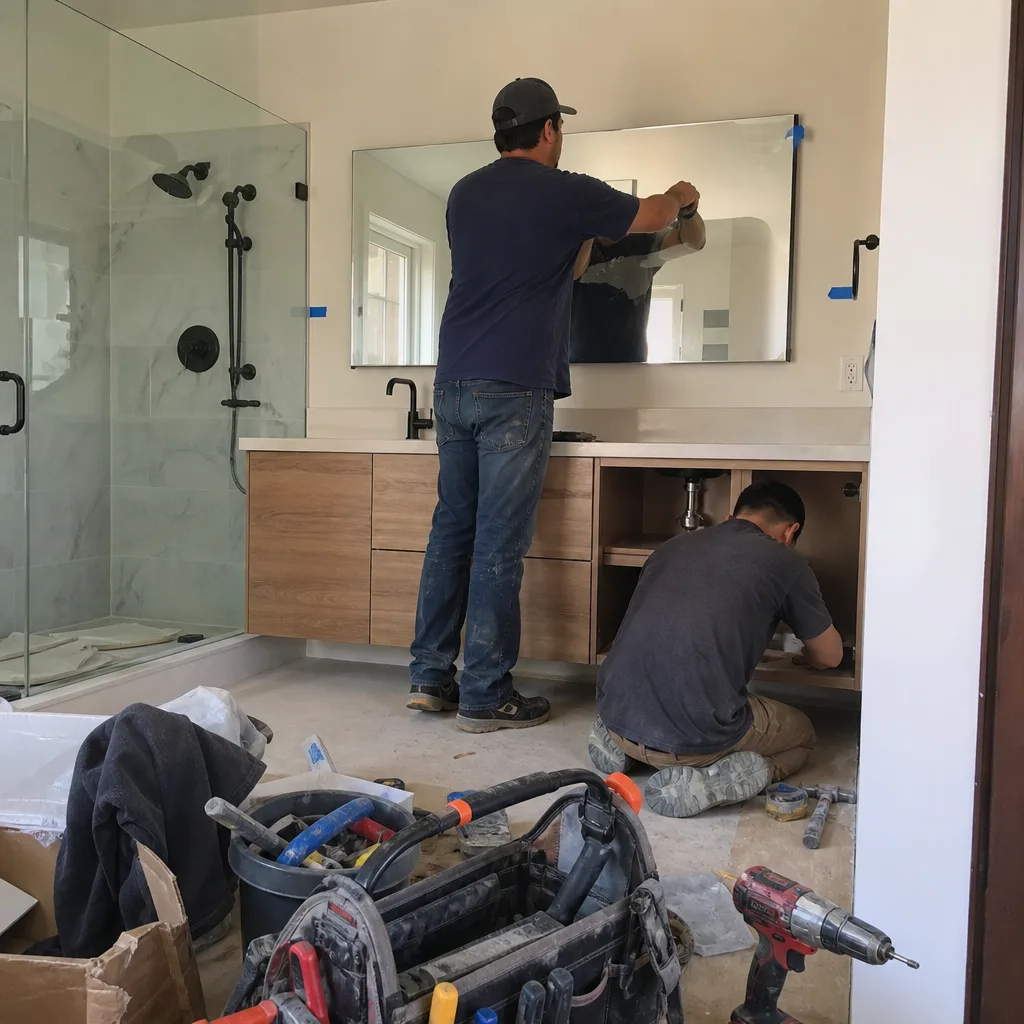
A kitchen remodel generates paper that most homeowners file and forget. The maintenance events of years three through ten require this documentation. Here is what belongs in a single folder, physical or digital, that you can find in under 60 seconds.
- Permit card and inspector sign-off: The final inspection card proves work was done to code. If you sell, buyers’ inspectors ask. If you have a warranty dispute, the permit record establishes the work scope and date. Mountain View Building Division records are public but retrieving them takes time; your copy is instant.
- Written contract and change orders: The scope definition. If a cabinet delaminates and you need to prove it was included in the original spec, this is your evidence. At Rowan Construction Group, every change order is signed before work proceeds - Clause 1 of The Haven Standard - and the final project file includes all of them.
- Appliance model and serial numbers, with installation dates: As discussed above. Warranty periods vary by component; the compressor in your refrigerator may have a longer warranty than the ice maker.
- Grout color code and manufacturer: For any tile repair, color match is essential. Include a photo of the grout line in natural light - colors shift under artificial light.
- Paint colors and sheens: Walls, ceiling, trim, cabinet paint. Benjamin Moore and Sherwin-Williams formulas are retrievable if you have the color number, but “something like Swiss Coffee” is not.
- Countertop material, slab lot number, and sealer product used: For natural stone, the lot number matters for repair or extension. The sealer product determines reapplication schedule and compatibility.
- Plumbing fixture model numbers and valve cartridges: When the faucet drips at year four, the cartridge part number is on the documentation. Without it, you are disassembling the faucet to read a number stamped inside.
- Electrical panel legend updated for new circuits: The kitchen likely added GFCI circuits, dedicated appliance circuits, and possibly a subpanel. The panel legend should reflect this. We provide an updated legend as part of project closeout.
The documented photo record we provide with every project - included as standard, not an upgrade - serves as visual documentation of concealed conditions: framing before drywall, plumbing before insulation, electrical before cover. If you ever need to locate a pipe or wire without destructive investigation, these photos are invaluable.
Common Mistakes to Avoid
- Using vinegar on natural stone: The acidity etches marble and limestone permanently. We have seen Calacatta countertops dulled by “green cleaning” advice that ignores material chemistry.
- Overtightening cabinet hinge screws: The mounting plate holes in frameless cabinets are engineered for precise torque. Stripped holes require epoxy repair or plate relocation - entirely avoidable with a hand screwdriver instead of a drill.
- Ignoring the range hood damper: A stuck exterior damper costs nothing to free but wastes hundreds in conditioned air loss annually. Mountain View’s marine layer can corrode the hinge; a drop of oil prevents this.
- Steam-cleaning LVP flooring: The heat and pressure delaminate the wear layer from the core. Manufacturer warranties explicitly exclude steam damage.
- Waiting for a drip to inspect under-sink plumbing: By the time water reaches the cabinet floor, the subfloor and cabinet base are already damaged. Quarterly dry-towel inspection catches seepage before it becomes visible.
- Discarding appliance manuals: The troubleshooting section prevents unnecessary service calls. A dishwasher not draining is often a clogged air gap - a 5-minute fix if you know where to look.
- Assuming quartz is indestructible: It resists stains and scratches better than most materials, but thermal shock cracks it instantly. The “I always set hot pans down” habit ends with a replacement countertop.
When to Call a Professional
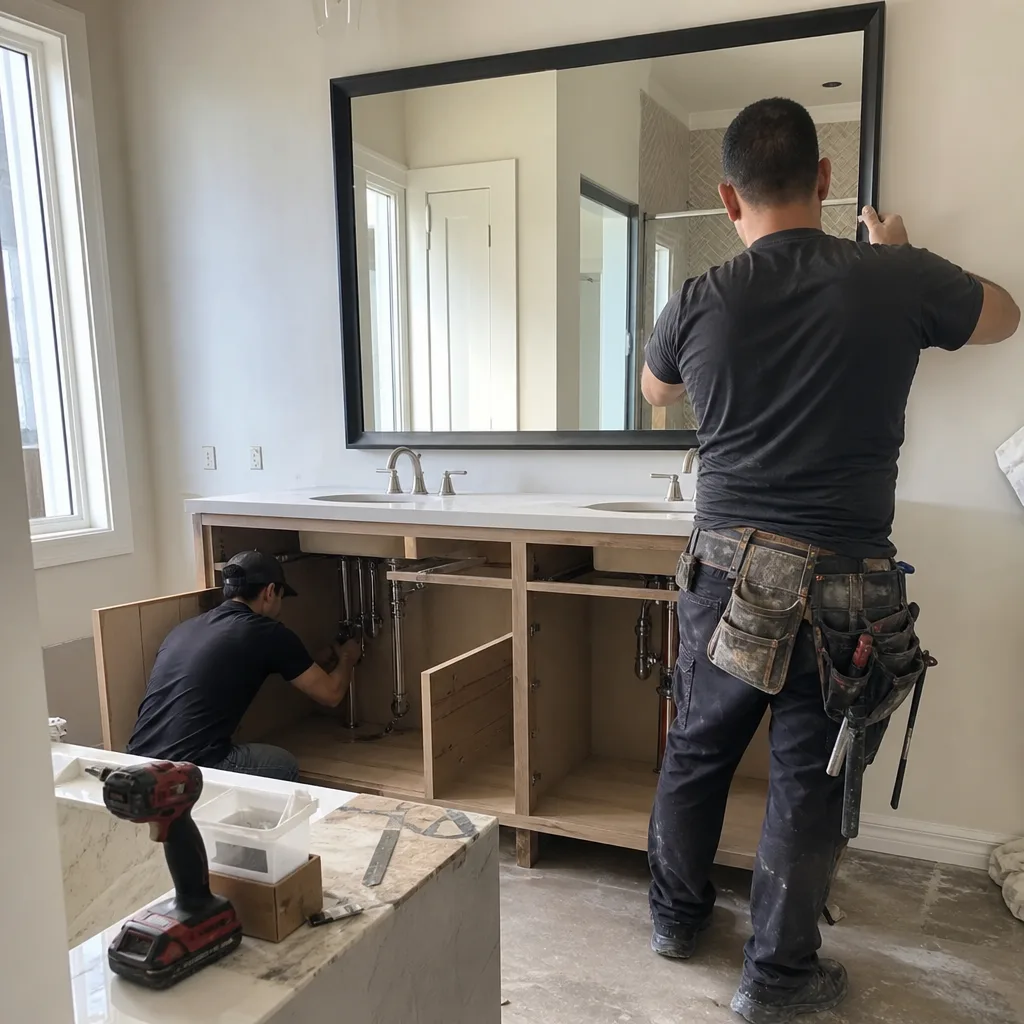
Some maintenance tasks require tools or expertise beyond homeowner capability. Call a licensed contractor or specialist for: gas line work of any kind; electrical panel modifications or GFCI troubleshooting that does not resolve with reset; countertop seam separation or substrate failure; tile re-grouting involving structural movement cracks; or duct cleaning for hood systems over 600 CFM. Water damage behind tile or under cabinets spreads rapidly - the cost of professional assessment is minor compared to mold remediation or cabinet replacement.
Rowan Construction Group Mountain View offers free estimates in Mountain View - call (669) 215-4852. We also provide a Free Second Opinion on any written estimate from another contractor, reviewed line by line at no charge. Our 365-Day Done Right Promise means if it is not done right, we make it right, backed by The Haven Standard terms page, not an asterisk.
Frequently Asked Questions
Annual maintenance for a typical $60,000-$80,000 kitchen remodel runs $200-$500 in materials and DIY labor, or $800-$1,500 if you hire professionals for sealing, inspection, and appliance service. Natural stone countertops add $150-$300 annually for professional sealing; quartz adds nothing. Call (669) 215-4852 for an exact quote - estimates are free.
Quartz never needs sealing. Calacatta marble and other porous natural stones need penetrating sealer every 6-12 months. Granite typically needs annual sealing, though some dense varieties like Absolute Black can go 18-24 months. Test by dripping water: if it absorbs in under 10 minutes, reseal regardless of schedule.
At Rowan Construction Group, no work proceeds on a change until the change order is signed. The administrative discipline Haven acquired us for - and the reason our projects finish within a few percent of the agreed cost across 4,000-plus jobs since 2007. Your written price is your price.
Pure maintenance - sealing, cleaning, hardware adjustment - requires no permit. Replacement of like-for-like appliances typically does not. Moving a gas line, adding or relocating electrical circuits, or structural modifications do require Mountain View Building Division permits. We pull all required permits and pass all inspections as part of any project scope.
Quality frameless or face-frame cabinets with proper maintenance last 20-30 years. Hinges and drawer slides are replaceable components; the box itself fails only from water damage or structural abuse. In Mountain View’s climate, humidity-related swelling is minimal - the enemy is leaks, not weather.
The flexible sealant joint at the countertop-to-backsplash junction. It is invisible when correct, conspicuous when failed, and absent from most homeowner handoff documents. Check it at 6, 12, and 18 months, then annually. The 18-month check is critical - that is when initial settlement movement completes.
The Bottom Line

A kitchen remodel in Mountain View represents a significant investment protected by specific, material-dependent maintenance. Quartz needs no sealing but cannot take heat; marble needs biannual sealing but develops character; frameless cabinets need semi-annual hinge checks but reward you with crisp alignment for decades. The common thread is documentation - knowing what you have, when it was installed, and what the manufacturer specifies. The contractors who deliver this information in writing at project closeout separate themselves from those who do not. We have delivered 4,000-plus projects since 2007, every one with a written price before work started, a documented photo record when the crew left, and the maintenance guidance the homeowner needs to protect the result.
Written by Grant Rowan, Owner at Rowan Construction Group Mountain View, serving Mountain View since 2007.